
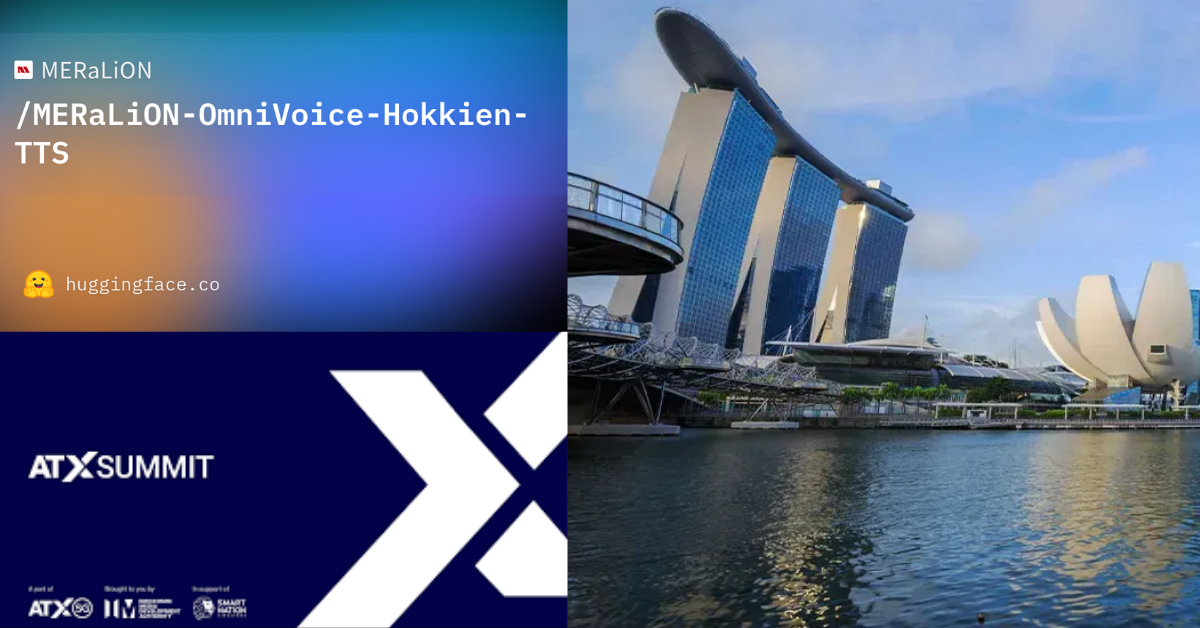
A team in Singapore has released an open-source AI voice model built specifically for Singapore Hokkien, a language many locals grew up hearing at home but rarely see properly supported in modern technology.

The model, MERaLiON-OmniVoice-Hokkien-TTS, was launched during the ATxSummit and is designed to read and speak Hokkien using local pronunciation, tones, rhythm, and mixed-language speech patterns commonly heard in Singapore.
The project is publicly available through Hugging Face.
Why this is difficult for normal AI systems
Most Chinese AI voice systems automatically default to Mandarin pronunciation when reading Chinese characters, even when the text is clearly written in Hokkien.
Singapore Hokkien also contains a strong mix of Malay, English, and dialect slang that developed over decades of local usage.
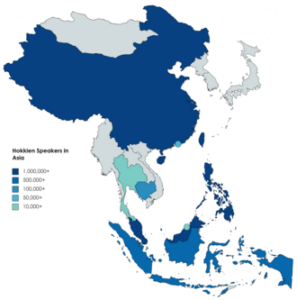
Words adapted from Malay, such as “kahwin” becoming “kah yin” or “gaduh” becoming “gah loh,” are commonly understood in local speech but difficult for standard AI systems to process naturally.
The team said the goal was to create a model that reflects how Singapore Hokkien is actually spoken instead of forcing it into Mandarin-style pronunciation.
What the model can do
According to the developers, the system can:
- Read Singapore Hokkien text naturally
- Handle mixed-language local slang
- Clone voices from short audio samples
- Run locally without requiring cloud APIs
The model reportedly scored 8.4/10 for naturalness during testing.
Unlike many large commercial AI systems, it can also run on a consumer-grade GPU without depending on external servers.
Language, identity, and local speech
The release also sparked discussion online about how Hokkien in Singapore developed differently from standard Mandarin.
Some users pointed out that many people casually call Hokkien a “dialect,” even though it functions as its own language system with distinct vocabulary, pronunciation, and historical roots.

Others shared older slang terms and expressions they hoped the AI could eventually preserve, especially phrases commonly used by older generations in Singapore during the 1960s to 1990s.
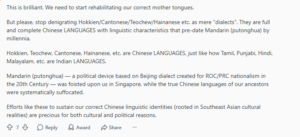
The developers said they are also exploring support for other Southeast Asian languages and local speech varieties in future versions.
See the post here:
大家好,食饱未? We built an open-source Text-to-Speech AI specifically for Singapore Hokkien
byu/Worth_Contract7903 insingapore
More from Wake Up Singapore:-
British Tourist Walks 15K Steps to Spot Otters in Singapore, Leaves Without Spotting Any
“Bro Really Wanted Full Tank”: Singapore Driver Shakes Car While Refueling
Mango Season Lands in Singapore with Full Indian Lineup at Mustafa Centre
If you have a story or a tip-off, email admin@wakeup.sg or get in touch via Whatsapp at 8882 5913.
Interested in advertising on our media channels? Reach out to us at admin@wakeup.sg!
Since you have made it to the end of the article, follow Wake Up Singapore on Telegram and X!
Wake Up Singapore is a volunteer-run site that covers alternative views in Singapore. If you want to volunteer with us, sign up here!