
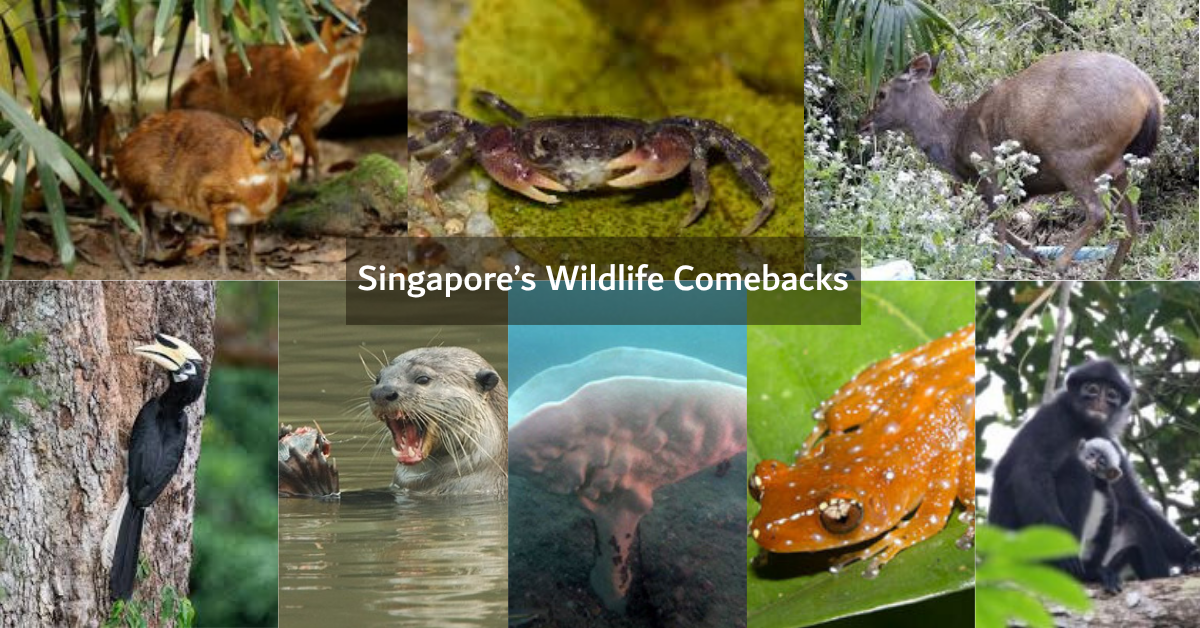
Some animals thought to be gone from Singapore have made a comeback thanks to long-term conservation efforts.
From mouse-deer missing for decades to hornbills, otters, frogs, deer, and even a sponge once believed extinct globally, these are Singapore’s wildlife recovery stories across land and sea.
Great Mouse-Deer
The Great Mouse-Deer is a small hoofed mammal that was thought to be locally extinct for around 80 years.
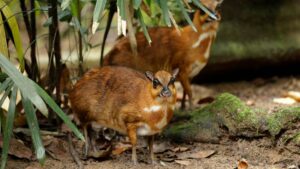
In 2008, the species was again found on Pulau Ubin, and habitat restoration and forest conservation programmes led to an increase in its population.
Raffles’ Banded Langur
Banded Langur is a native primate species of the Raffles.
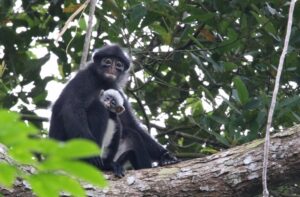
It is estimated that there were only around 10 left in Singapore in the 1980s. The population has since rebounded due to conservation measures, including genetic research and better connectivity between forest habitats.
Neptune’s Cup Sponge
In 1908, it was thought that the Neptune’s Cup Sponge was extinct throughout the world.
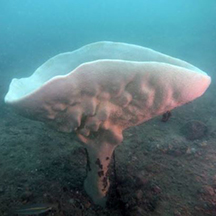
In 2011, living specimens were found off Singapore’s coast and scientists have been working on breeding and reintroducing them in marine conservation programmes, including at Sisters’ Islands.
Cinnamon Bush Frog
The Cinnamon Bush Frog was also impacted by habitat loss.
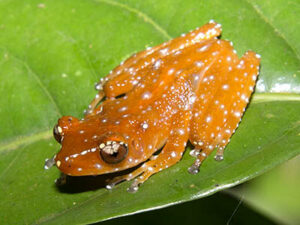
Conservationists were introduced tadpoles in protected habitats such as the Singapore Botanic Gardens in 2021 and by 2023 there were signs of increase in the populations.
Singapore Freshwater Crab
The Singapore Freshwater Crab is a species that is only present in Singapore.
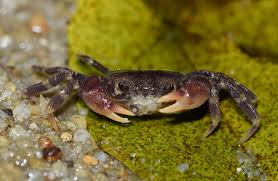
It was threatened by water pollution and habitat destruction, but was bred under conservation programmes and then released into safer freshwater environments.
Smooth-Coated Otter
Smooth-coated otters are now commonly seen in groups in mangroves, mudflats and coastal regions in Singapore.
They are generally considered to be cute but have a high territoriality and scent mark on land.
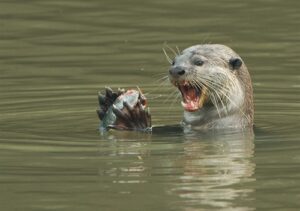
They are an indicator of better habitat protection and enforcement of the anti-poaching laws, but they are also sensitive to habitat loss and human disturbance.
Oriental Pied Hornbill
One of Singapore’s success stories in bird recovery is that of the Oriental Pied Hornbill.
It was once thought to be locally extinct, but later reappeared in places like Pulau Ubin where breeding was established.
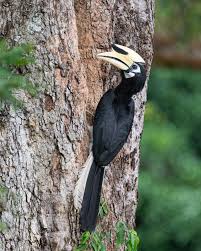
The return was facilitated by conservation activities such as the use of artificial nest boxes, introduced in 2005, and reintroduction programmes. It is now found in such locations as Pulau Ubin and Changi, where it frequently feeds on fruits and nests in larger trees.
Sambar Deer
Another animal that has come back to Singapore’s forests is the Sambar Deer.
The species was thought to be extinct by about 1950 but in the 1970s a few individuals were released from captivity and the species has since been seen again.
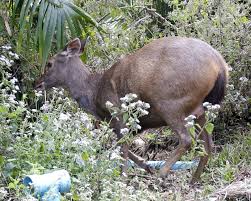
In recent times, there is an indication that the population has been increasing slowly in forest areas like the Central Catchment Nature Reserve and Bukit Timah.
Long-Term Conservation Work Behind Recoveries
The recoveries are the result of decades of conservation work by the Singapore authorities, including the restoration of habitats, protection of species and long-term environmental management in major nature reserves like Sungei Buloh Wetland Reserve, Mandai Wildlife Reserve, Central Catchment Nature Reserve, and others around the island.
More from Wake Up Singapore:-
Malaysia Policewoman Finds Teacher Who Quietly Saved Her Education Journey
Beyond the 24 Minute Walk: The Logistics of Chasing The Singaporean Dollar
Singapore Gardener Proudly Harvests Cherry Tomatoes Grown on a 2m x 1m Balcony Space
If you have a story or a tip-off, email admin@wakeup.sg or get in touch via Whatsapp at 8882 5913.
Interested in advertising on our media channels? Reach out to us at admin@wakeup.sg!
Since you have made it to the end of the article, follow Wake Up Singapore on Telegram and X!
Wake Up Singapore is a volunteer-run site that covers alternative views in Singapore. If you want to volunteer with us, sign up here!