
By Sonia Lourdes
“What can you actually do… useless”.
Ever had words like these echo at the back of your head growing up?
Maybe they came from a teacher. An uncle or auntie. A grandparent. A parent. Sometimes, they were merely said in passing – during moments of frustration, stress, or anger. But for many children, the impact lingers far beyond childhood.
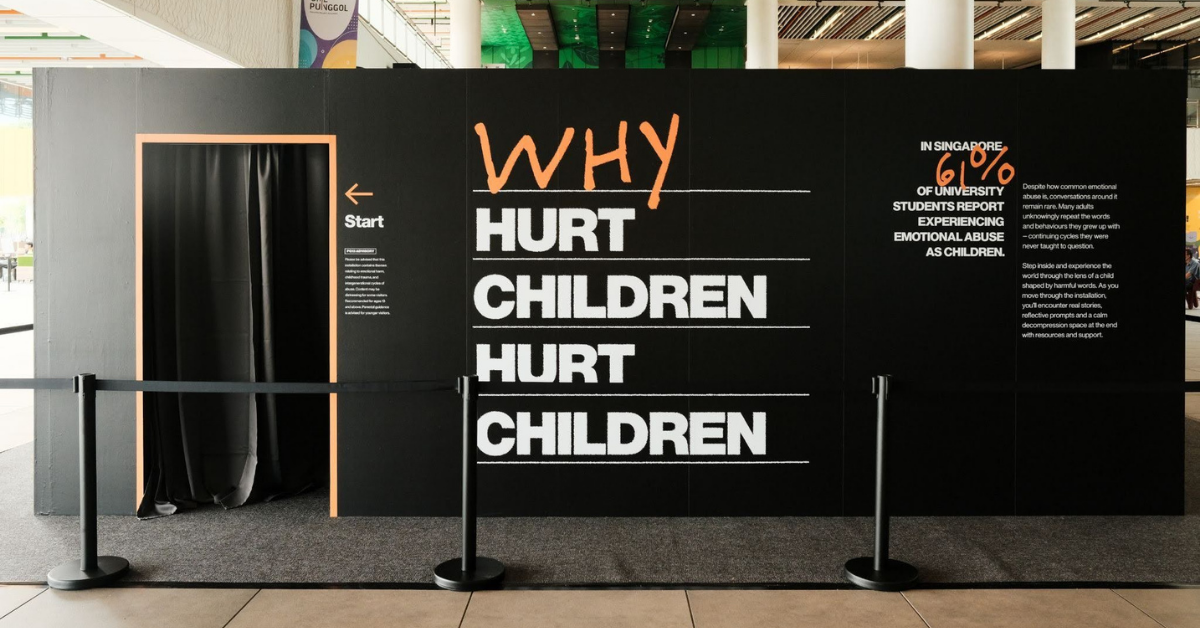
That uncomfortable reality sits at the heart of Why Hurt Children Hurt Children (WHCHC), an immersive installation by EveryChild.SG currently running at One Punggol until 31 May 2026 from 10am to 8pm. Through a silent-film-inspired black box experience, the exhibition explores the cycles of intergenerational emotional harm in Singapore; from sibling comparisons and shaming to the harsh words many grew up normalising.
Among those who attended the week-long exhibit was Workers’ Party (WP) member Alexis Dang, alongside fellow WP members Harpreet Singh and Jackson Au, with Harpreet later describing the installation as a powerful reminder of how “words leave very deep scars”.
Inside the installation, visitors are confronted with familiar phrases projected across dark walls: “Why are you always like this?”, “Can you be more like your sibling?”, “You dumb idiot”.
Beyond the emotionally charged visuals, the exhibition also presents research highlighting the scale of childhood emotional harm in Singapore. It highlights the prevalence of emotional harm experienced by children in Singapore. Research from the Institute of Mental Health found that 46.5% of Singaporeans experienced emotional neglect during childhood, while a 2025 study cited within the installation found that 61% of Singaporean university students reported experiencing emotional abuse growing up.

But the installation does not aim to shame parents or assign blame. Instead, it asks visitors to reflect on how emotional harm is often passed down subconsciously. Often repeated not necessarily out of cruelty, but because hurt behaviours were once normalised within families themselves.
There is also a familiar phrase many Singaporeans have probably heard, or even said themselves: “I grew up in this kind of environment and I turned out fine”.
Yet the exhibition quietly questions what “fine” really means. For some, it may look like growing up unable to express emotions openly, struggling with self-worth, carrying anger into adulthood, or repeating the same harsh communication patterns in relationships, workplaces, and eventually parenthood itself.
By confronting visitors with these realities, WHCHC pushes beyond nostalgia and cultural normalisation, asking whether emotional hurt should continue being accepted as a necessary part of growing up.

One of the exhibition’s most moving sections invites visitors to write down what they wished they had heard growing up. Scribbled across the wall were phrases like “You are enough”, “I’m proud of you”, and “I wish they went easier on me”, quiet reminders that even as adults, many people are still carrying younger versions of themselves that never fully healed.
And perhaps that is what makes the exhibition hit particularly hard, emotional harm rarely stays confined to childhood. The words we grow up hearing often shape the adults we become; how we speak, react, love, lead, parent, and even function in workplaces and relationships. Hurt children grow into hurt adults, and without reflection, the cycle repeats itself in different forms.

In that sense, WHCHC is more than just an exhibition. Backed by trauma-informed research and psychological insights, the installation highlights how childhood emotional experiences – particularly persistent shaming, harsh criticism, and emotional neglect – can quietly shape adult struggles later in life, from anxiety and self-worth issues to difficulties in relationships and communication.
More importantly, the campaign encourages visitors to recognise and name these experiences, many perhaps for the first time. And according to mental health professionals, that awareness is often the first critical step toward healing, reflection, and ultimately breaking cycles of emotional harm before they are passed on to the next generation.
More from Wake Up Singapore:-
Introducing Long Long Tales 龙龙故事 A Bilingual Kids’ YouTube Series
If you have a story or a tip-off, email admin@wakeup.sg or get in touch via Whatsapp at 8882 5913.
Interested in advertising on our media channels? Reach out to us at admin@wakeup.sg!
Since you have made it to the end of the article, follow Wake Up Singapore on Telegram and X!
Wake Up Singapore is a volunteer-run site that covers alternative views in Singapore. If you want to volunteer with us, sign up here!