

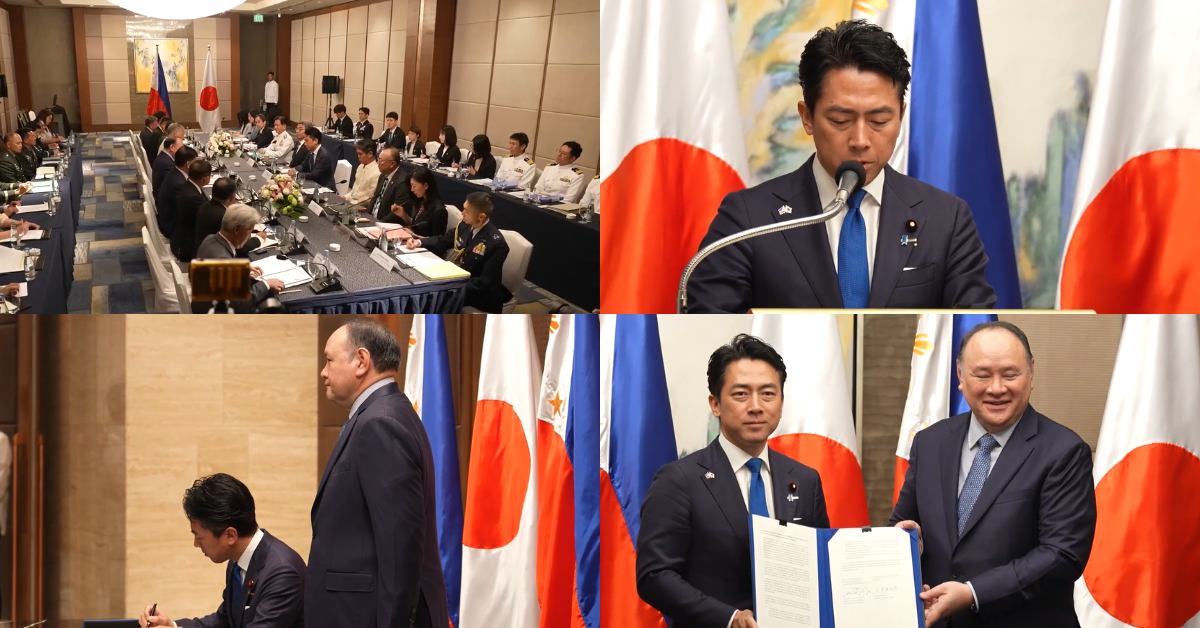
Japan and Philippines Expand Defence Cooperation
Japanese Defence Minister Shinjiro Koizumi and Philippine Defence Secretary Gilberto Teodoro agreed on Tuesday to fast-track the transfer of Abukuma-class destroyers and TC-90 aircraft to the Philippines.
The agreement was reached during talks in Makati and followed Japan’s landmark revision of defence export rules, which allowed the sale of warships, missiles and other weapons.
“We agreed to move forward with discussions aimed at realising comprehensive equipment cooperation, including education and training, maintenance and sustainment, operational coordination, and information sharing,” the Japanese Defence Minister stated.
The agreement is part of broader efforts by Japan and the Philippines to strengthen defence cooperation in policy, operations, equipment and technology amid rising regional and global security tensions.
“As the regional and international security environment becomes increasingly severe, Japan and the Philippines have been working in close coordination,” Koizumi stated.
Balikatan Exercises Mark Historic Military Shift
Koizumi’s visit coincided with Exercise Balikatan 41-2026 in the Philippines. On Wednesday, he is expected to join representatives from 16 other countries to observe the annual drills.
“By applying the Reciprocal Access Agreement (RAA) – which entered into force in September last year – to the ongoing US-Philippines hosted multilateral exercise, Balikatan 26, we were able to bring equipment to the Philippines and participate in more advanced training, which had not been possible previously. As a result, the quality and quantity of the exercise have improved dramatically,” Koizumi said.
Around 1,400 troops from Japan’s Self-Defence Forces joined more than 17,000 personnel from the Philippines and the United States for the 2026 Balikatan joint military exercises. The deployment marks a historic shift for Tokyo, with Japan taking part with combat-capable troops for the first time since World War II, rather than joining the drills only as an observer.
During Balikatan 2026, US Marine forces deployed the Navy-Marine Expeditionary Ship Interdiction System (NMESIS), a land-based robotic weapon system designed to neutralise highly secure maritime and land targets, to a remote Luzon Strait island located just 100 miles south of Taiwan.
Regional Tensions and China’s Response
The move came as China’s relations with both Japan and the Philippines hit their lowest point in decades.
Ties between Beijing and Tokyo remained strained after the Japanese prime minister remarked on protecting Taiwan’s security, while China and the Philippines continued to clash over longstanding territorial disputes in the South China Sea.
Following the drills’ launch, Chinese Foreign Ministry spokesperson Guo Jiakun urged peace in the Asia-Pacific region, calling against “division and confrontation as a result of the introduction of external forces.” China also launched naval exercises east of Luzon Island in response, focusing on live-fire drills, sea-air coordination and rapid manoeuvres.
Article by Viory