

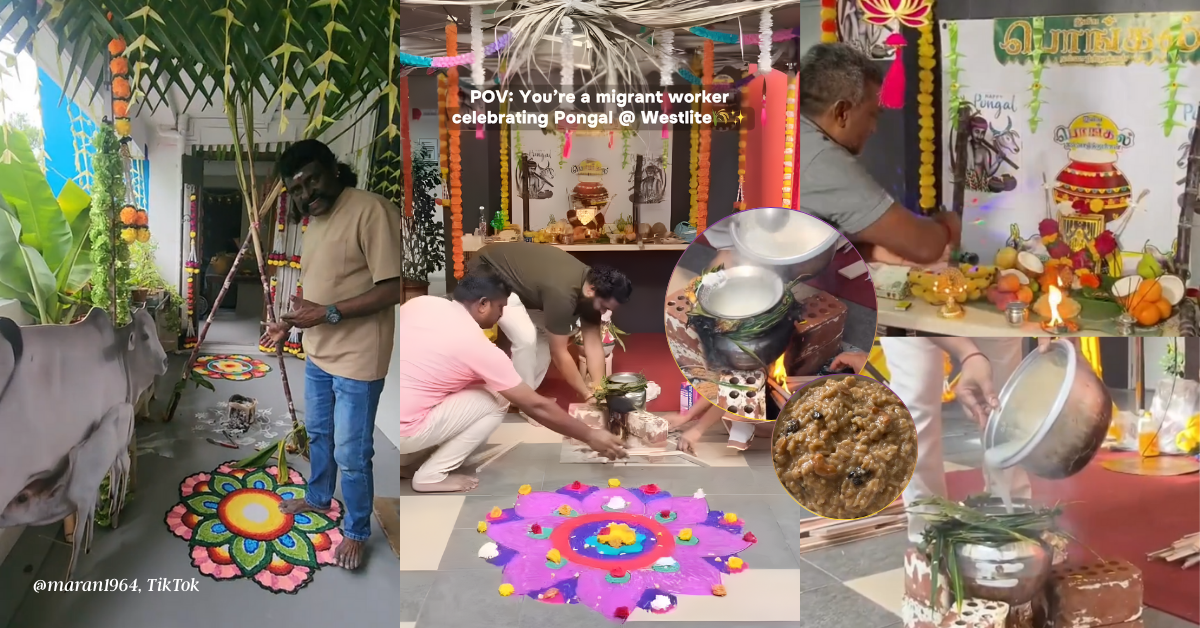
Colourful Pongal Decorations in Home Corridor
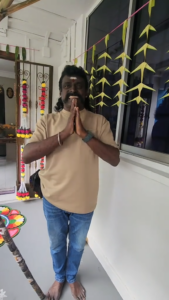
Celebrated in homes, fostering community and togetherness, this year’s Pongal celebrations were hard to miss. A TikTok video posted by user @maran1964 offers viewers a vibrant glimpse into Pongal celebrations taking place in Singapore’s heartlands. Maran, in the video, first addresses the audience and then smoothly moves the camera across the corridor outside his house. He decorated the area with a modern twist on tradition for Pongal.
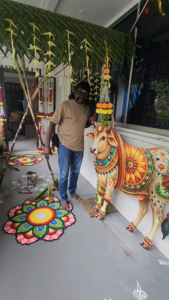
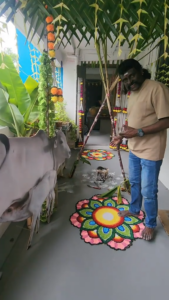
The area was adorned with beautiful kolams, cows cutouts, marigold garlands, palm leaves that were woven, and ceiling festoons. The presence of sugarcane stalks added to the celebration mood significantly. All the decorations collectively made the spirit of Pongal go beyond the confines of the home.
Maran’s post also allows us to highlight the cultural and religious importance of sugarcane during Pongal. Sugarcane symbolises sweetness and happiness, but it is also linked to a religious story associated with Lord Shiva. According to tradition, on a Perum Pongal day, Lord Shiva—known as Lord Sundareshwar at the Madurai Meenakshi Temple—performed a miracle by feeding sugarcane to a stone elephant image. A stone carving depicting this event can still be found in the temple today.
Other essentials commonly used during Pongal were also noted. The neck of the pongal panai—the pot used to cook Pongal—is typically tied with fresh turmeric leaves, and in some regions, tender ginger leaves are also used. These green leaves symbolise prosperity and growth.
Migrant Workers Celebrate Pongal At Westlite Ubi
Another TikTok video, shared three days ago by @westlite.sg, showed migrant workers celebrating Pongal at Westlite Ubi.
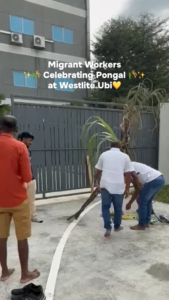
The in-video caption read, “Migrant Workers Celebrating Pongal at Westlite Ubi,” while the post caption described Pongal as a festival of harvest, gratitude and new beginnings.
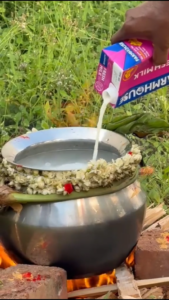
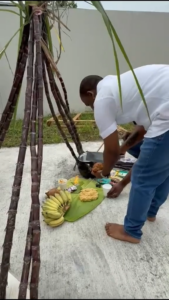
The video captured a traditional Pongal ritual where water and milk were boiled in a pot tied with a turmeric plant, placed over a wood fire and set beneath upright sugarcane stalks.

Offerings were laid out on a banana leaf nearby. A group of migrant workers carried out the ritual together before applying vibhuti, marking the completion of their prayers.
Games, Food And Smiles At Westlite Woodlands
A second video posted two days ago by @westlitesg on Instagram showed similar celebrations at Westlite Woodlands.
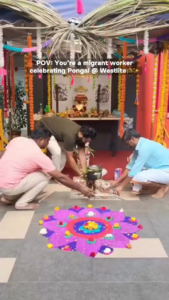
The caption described a day filled with laughter, shared traditions and meaningful moments. Residents came together to mark the harvest festival.
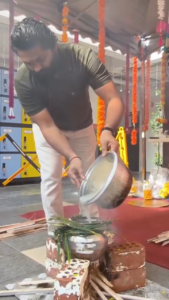
The footage showed workers boiling rice and milk until it overflowed—a key part of the Pongal ritual—in front of a colourful kolam. Sugarcane stalks were again placed upright across the venue.

Workers then offered prayers, the workers were served Pongal and took part in various games.

Many were seen smiling and cheering as they played and observed the activities, reflecting a strong sense of community.
What Pongal Represents
The Pongal festival which is celebrated by the Tamil community is their way of thanking the Sun, nature, and domestic animals for a bountiful harvest. As per indianheritage.gov.sg, the festival stretches over 4 days and signifies the beginning of the Tamil month of Thai, which is termed as very lucky. Pongal usually takes place on the 14th or 15th of January.
The word “Pongal” is not just the name of the festival but it represents the dish served during the celebrations too. The word is derived from the Tamil word pongu which means “to boil over;” this signifies prosperity and abundance.
The first day, Bhogi, symbolizes a fresh new start, houses being cleaned, old items being thrown away, and the homes being decorated. The second day, Surya Pongal, honours the Sun God. Families draw kolams at their entrances and cook fresh rice with milk at auspicious timings, joyfully shouting “Pongalo Pongal” as the milk boils over.
The third day, Maattu Pongal, is dedicated to honouring cattle for their role in agriculture. The fourth day, Kaanum Pongal, centres on family, community bonding and cultural performances.
Making Pongal at Home
Finally, a video from Malaysia shows @theweekanne sharing how her mother prepares Pongal in collaboration with a local milk powder brand. In the video, she explains that Pongal is a time to practise gratitude to Mother Earth, gather loved ones and enjoy food together.
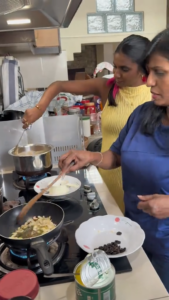
Her mother demonstrates the recipe with step-by-step instructions, from rinsing rice and boiling it with water and salt, to roasting cashews in ghee, and finally stirring in the milk powder.

The clip ends with a cheerful “Happy Pongal from our family to yours,” reinforcing how the festival continues to connect families and communities across borders.
Watch the videos here:
@maran1964
@westlite.sg Our residents came together to celebrate Pongal, a festival of harvest, gratitude, and new beginnings 🌾✨ May this Pongal bring abundance, joy, and warmth to you and your loved ones. From our Westlite family to yours, Happy Pongal! 💛
@theweekanne everyone that comes to my house say they come for the Pongal vibes.. but we know it’s really for this bowl ©️ Our secret recipe? It’s made deliciously rich with Fernleaf Full Cream Milk Powder!@Fernleaf Malaysia From our home to yours, Happy Pongal! #FernleafMY #HappyPongal #FernleafPonggal
More from Wake Up Singapore:-
Blending Traditions: Chinese Lion Dance Joins Hindu Kavadi in Singapore’s Thaipusam Festivities!
If you have a story or a tip-off, email admin@wakeup.sg or get in touch via Whatsapp at 8882 5913.
Interested in advertising on our media channels? Reach out to us at admin@wakeup.sg!
Since you have made it to the end of the article, follow Wake Up Singapore on Telegram and X!
Wake Up Singapore is a volunteer-run site that covers alternative views in Singapore. If you want to volunteer with us, sign up here!