


A healthcare worker in Singapore has drawn attention online after sharing a breakdown of her working hours for one week, revealing a total of 81 hours on the job.
The staff posted the figures under the caption “average week at work,” showing how her hours were spread across the week. Her post quickly attracted comments from people discussing healthcare workloads, salaries, working-hour limits, and the demands placed on doctors and nurses.

According to the breakdown, she worked 11 hours on Monday, 12 hours on Tuesday, 11 hours on Wednesday, and 11 hours on Thursday. She then recorded 30 hours from Friday to Saturday, followed by another six hours on Sunday.
That brought her total to 81 hours for the week.
Her 81-Hour Week Gets Attention
The post prompted one commenter to write, “Got money but no time,” while another joked that people would have more time when they were older.
Others focused on the workload rather than the salary. One commenter said doctors at this stage of their careers may not be earning as much as people assume, particularly before specializing or moving into general practice.
The same commenter claimed that public healthcare workers, including doctors, can be paid less than their private-sector counterparts.
Another user asked how much “underpaid” doctors could be, while a separate commenter simply wrote, “No money where the food got bills to pay.”

The discussion also expanded beyond doctors, with some users comparing their working hours with those of nurses. One commenter said nurses also work roughly similar hours but receive “lesser the glory.” Another user pushed back against the idea of healthcare workers having much glory, saying both doctors and nurses face demanding work regardless of their titles.
Commenters Debate Whether 80 Hours Is the Limit
The 81-hour figure also caught the attention of a medical student, who asked whether doctors are subject to an 80-hour weekly limit.
The question led to jokes about what would happen if a medical staff reached 80 hours during an emergency. One commenter suggested that a doctor could not simply leave because they had reached the weekly figure.
The discussion then turned to the realities of on-call work.
One commenter questioned whether the 30 hours recorded from Friday to Saturday involved being on call and suggested that doctors might spend much of that period waiting.
Another commenter disagreed, explaining that certain hospital departments can remain extremely busy overnight. They mentioned areas such as emergency-related work and medical oncology, where doctors may deal with admissions, urgent calls, blood cultures, and resuscitation.
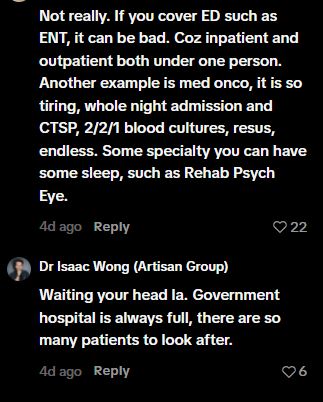
A person commenting under the name Dr. Isaac Wong also responded to the idea that doctors were simply waiting during on-call periods, saying government hospitals are often full and medical staff have many patients to look after.
Public and Private Healthcare Spark More Discussion
Several commenters also discussed working hours at polyclinics and general practitioner clinics.
One commenter claimed that medical workers at polyclinics and GPs generally work office hours and leave when clinics close. Another commenter corrected this, saying polyclinic doctors may need to remain until patients registered under them have been completed.
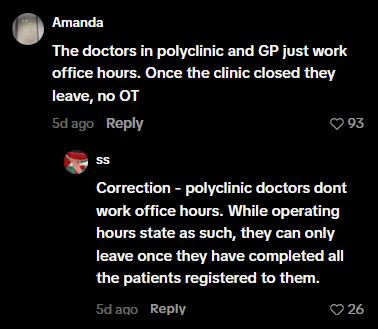
A further reply described how some polyclinics may stop accepting patients before closing and redistribute remaining patients among doctors who have already cleared their queues. Another commenter cautioned that practices at a handful of polyclinics may not represent the wider reality.
The conversation also moved into Singapore’s medical education system. One commenter questioned why local universities limit the number of Singaporean students entering medical school, saying some students had moved to the UK and Australia after failing to secure places.
Another commenter argued that increasing the number of medical workers could eventually affect salaries because of greater competition. A separate commenter raised the issue of foreign doctors being brought into Singapore while local students may struggle to secure medical-school places.
Meanwhile, some commenters questioned the doctor’s reported salary. One user suggested that someone at her career level could earn around S$4,000, although the figure was presented as a comment rather than verified information.

Not everyone viewed the post negatively. Several commenters praised the doctor, with messages including “solid stuff, doc,” “thank you for your service,” and encouragement to take care of herself.
The discussion ultimately covered a wide range of views, from long working hours and on-call duties to medical training, salaries, staffing, and working conditions across Singapore’s healthcare sector.
See the video here:
@charblergh
More from Wake Up Singapore:-
Uzbek Student Shows His SG Apartment, Viewers Debate If S$500 Shared-Room Rent Is Too Much
TikToker Gives Upcoming RTS Link Preview, Showing New Facilities And Routes To JB
Support SIET–SINDA Charity Golf 2026 And Help Indian Students Facing Financial Hardship
If you have a story or a tip-off, email admin@wakeup.sg or get in touch via Whatsapp at 8882 5913.
Interested in advertising on our media channels? Reach out to us at admin@wakeup.sg!
Since you have made it to the end of the article, follow Wake Up Singapore on Telegram and X!
Wake Up Singapore is a volunteer-run site that covers alternative views in Singapore. If you want to volunteer with us, sign up here!