

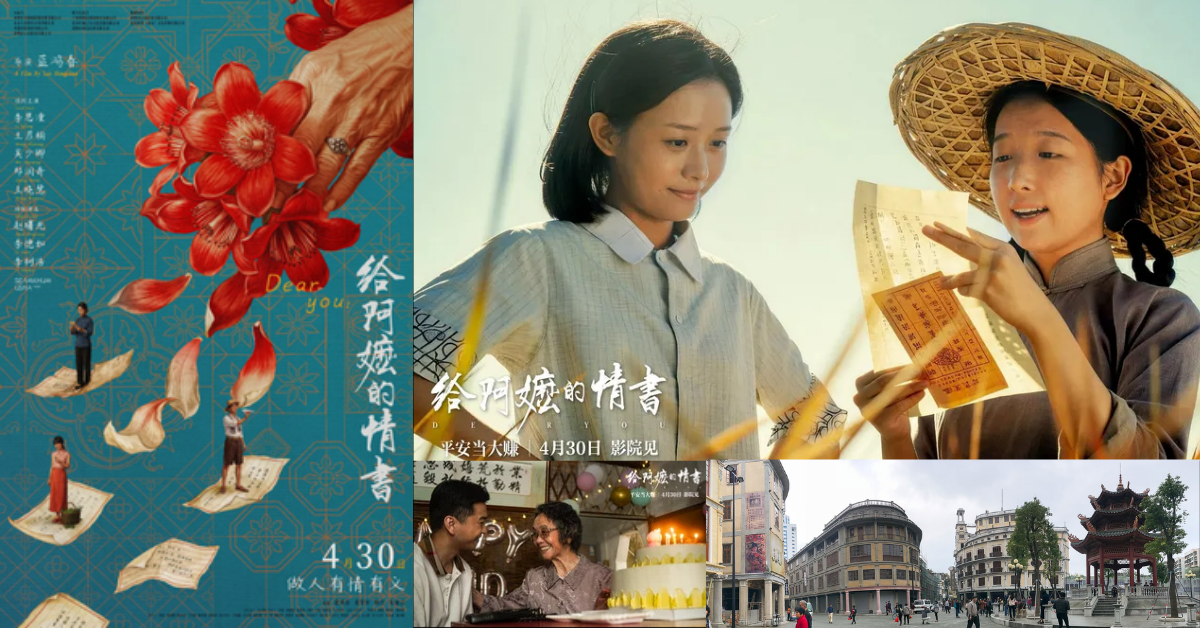
Dear You has unexpectedly become one of China’s biggest breakout films this year, with audiences stunned not just by the emotional story but also by how little the production team reportedly had while making it.
The film currently holds a 9.1 rating on Douban, making it one of the few domestic Chinese films in the past decade to open above 9.0.
What shocked many online even more was learning that the crew reportedly filmed parts of the movie in Thailand using little more than a DSLR camera, a boom microphone, and a tablet for playback.
Many netizens joked that the setup looked “smaller than a student project,” yet the final result became one of the most talked-about films in China right now.
A deeply emotional overseas Chinese story
The film follows the emotional connection between Ye Shurou, a grandmother from Chaoshan, and Xie Nanzhi, a Thai-Chinese woman who quietly supports Ye’s family for years through remittance letters known as “Qiaopi.”
Although the two women are not related by blood, the story explores decades of loyalty, sacrifice, and care across generations and borders.

Much of the film is spoken in the Chaoshan dialect, mixed with Mandarin and Thai, yet viewers across China still connected strongly with its emotional storytelling.
The cast had almost no acting background
Part of the film’s realism also came from its unusual casting choices.
Lead actress Li Sitong was reportedly still a second-year financial engineering student when she auditioned for the role. According to production stories shared online, her parents initially worried the film crew might be a scam.

Meanwhile, actress Wu Shaoqing, who played the grandmother, was previously known online as a Chaoshan internet personality and had no formal acting training.
Several scenes and emotional lines that audiences praised were reportedly improvised during filming.
Raw storytelling wins over audiences online
Made on a reported budget of around 14 million yuan (about S$2.6 million), the movie exploded online mostly through word-of-mouth, with viewers flooding social media saying they cried through the film.

For many audiences, the appeal wasn’t flashy cinematography or celebrity casting. It was how raw and emotionally real the film felt. From the regional dialects to the imperfect, deeply human performances, many viewers said the movie carried a sincerity that bigger studio productions often lose trying to feel “perfect.”
More from Wake Up Singapore:-
China Revises Liushenyu Coal Mine Explosion Death Toll Amid Continuing Rescue Operations Efforts
China Launches Shenzhen Drone Expo Showcasing Future Low Altitude Aviation Technologies Globally
China Strengthens Russia Ties After Putin Visit Secures Over Forty Bilateral Cooperation Agreements
If you have a story or a tip-off, email admin@wakeup.sg or get in touch via Whatsapp at 8882 5913.
Interested in advertising on our media channels? Reach out to us at admin@wakeup.sg!
Since you have made it to the end of the article, follow Wake Up Singapore on Telegram and X!
Wake Up Singapore is a volunteer-run site that covers alternative views in Singapore. If you want to volunteer with us, sign up here!