

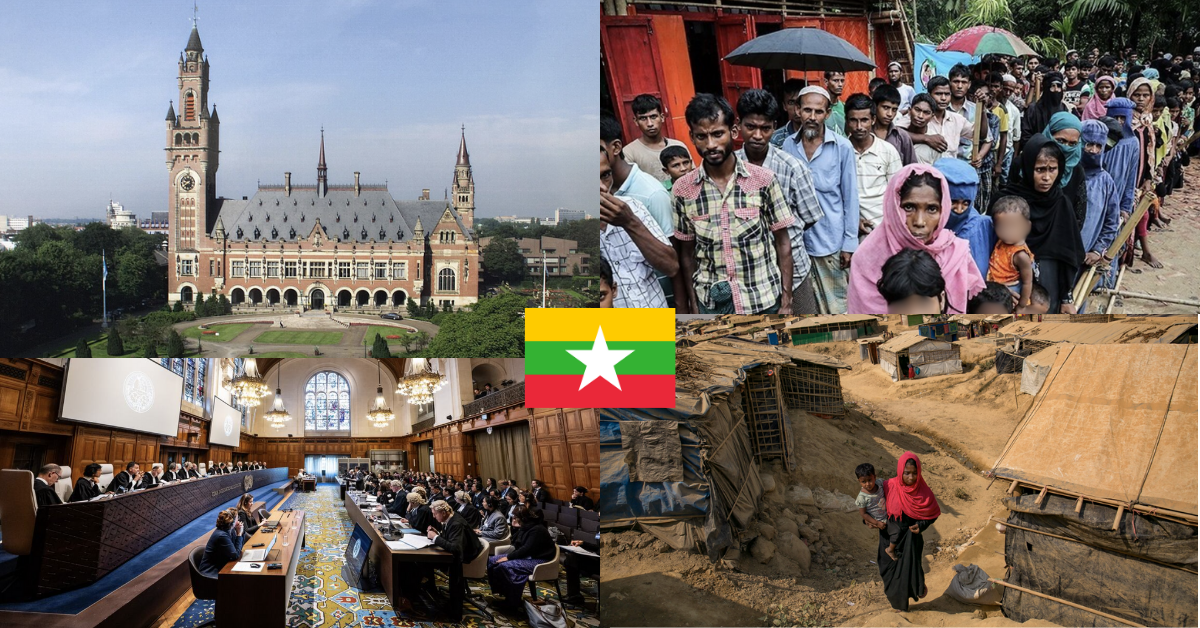
Myanmar Opens Defence at UN World Court
Myanmar has formally begun its defence at the International Court of Justice (ICJ), rejecting all allegations that it committed genocide against the Muslim Rohingya minority.
Addressing judges at The Hague on Friday, Myanmar’s agent Ko Ko Hlaing said the country recognises the 1948 Convention on the Prevention and Punishment of the Crime of Genocide, but denies breaching its obligations under international law.
“A finding of genocide would place an indelible stain on my country and its people,” he told the Court, describing the proceedings as “of fundamental importance for my country’s reputation and future.”
Myanmar argued that the case brought by Gambia rests on “unsubstantiated allegations” and disputed claims that its military operations in northern Rakhine State in 2016 and 2017 were carried out with genocidal intent.
Military Operations Framed as Counter-Terrorism
Myanmar maintained that the military’s so-called “clearance operations” were counter-terrorism actions launched in response to attacks by armed groups.
“Obviously, Myanmar was not obliged to remain idle and allow terrorists to have free rein of northern Rakhine state,” Ko Ko Hlaing said, while acknowledging that civilians were killed and large numbers of people fled to Bangladesh during the violence.
He also rejected allegations that Myanmar denies the existence or rights of Muslims in northern Rakhine State, arguing that issues of citizenship, terminology and identity “have nothing to do with genocide.”
Myanmar further said it has complied with all procedural orders issued by the Court, including provisional measures imposed in January 2020, and has submitted regular reports on steps taken. It reiterated its stated commitment to repatriating displaced Rohingya from Bangladesh, citing bilateral agreements and delays caused by the COVID-19 pandemic and natural disasters.
High Burden of Proof Highlighted
Speaking on Myanmar’s behalf, Stefan Talmon, an international law professor at the University of Bonn, argued that Gambia must meet the highest standard of proof to establish genocide, describing it as “beyond a reasonable doubt.”
Talmon questioned Gambia’s legal reasoning, saying it does not follow the approach used in previous ICJ cases such as Bosnia v Serbia and Croatia v Serbia, and argued that the Court has historically set a very high bar for genocide findings.
To date, the ICJ has found a violation of the Genocide Convention only once, in relation to the Srebrenica massacre, where it ruled that Serbia failed to prevent genocide but did not directly commit it.
Hearings on the Merits Now Underway
Public hearings on the merits of the case began on 12 January 2026 at the Peace Palace in The Hague, marking the first time the Court is examining whether Myanmar violated the Genocide Convention.
Over three weeks, judges are hearing oral arguments from both sides, alongside expert testimony and evidence. The Court’s final judgment, expected months after hearings conclude, will be legally binding.
Gambia’s Case and Rohingya Displacement
Gambia filed its application in November 2019, alleging that Myanmar’s armed forces carried out widespread and systematic “clearance operations” against the Rohingya with genocidal intent.
Those operations escalated in 2017, forcing more than 700,000 Rohingya to flee to Bangladesh amid widespread killings, sexual violence and village burnings, according to UN investigations.
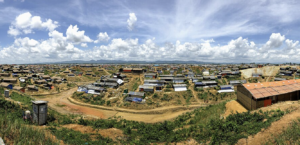
Nearly one million Rohingya continue to live as refugees in camps in Bangladesh.
In January 2020, the ICJ unanimously ordered Myanmar to take provisional measures to prevent genocidal acts, preserve evidence and report regularly to the Court. Myanmar later challenged the Court’s jurisdiction, but in July 2022, the judges rejected those objections, allowing the case to proceed.
Broader Accountability Efforts and Precedent
The case is the first time a country not directly affected by alleged atrocities has brought proceedings before the ICJ to enforce the Genocide Convention.
Human rights groups say the hearings carry significant weight for accountability, particularly following Myanmar’s February 2021 military coup and ongoing conflict across the country.
Beyond the ICJ case, the International Criminal Court has opened an investigation into alleged crimes against the Rohingya, and courts in Argentina have issued arrest warrants against senior Myanmar military figures under universal jurisdiction.
The proceedings are also closely watched internationally, as they serve as a legal reference point for other genocide cases brought before the ICJ, including South Africa’s application against Israel.
More from Wake Up Singapore:-
100+ Buildings Demolished, 2000 Scammers Arrested—Myanmar’s Biggest Scam Operation
If you have a story or a tip-off, email admin@wakeup.sg or get in touch via Whatsapp at 8882 5913.
Interested in advertising on our media channels? Reach out to us at admin@wakeup.sg!
Since you have made it to the end of the article, follow Wake Up Singapore on Telegram and X!
Wake Up Singapore is a volunteer-run site that covers alternative views in Singapore. If you want to volunteer with us, sign up here!






.jpg)
