

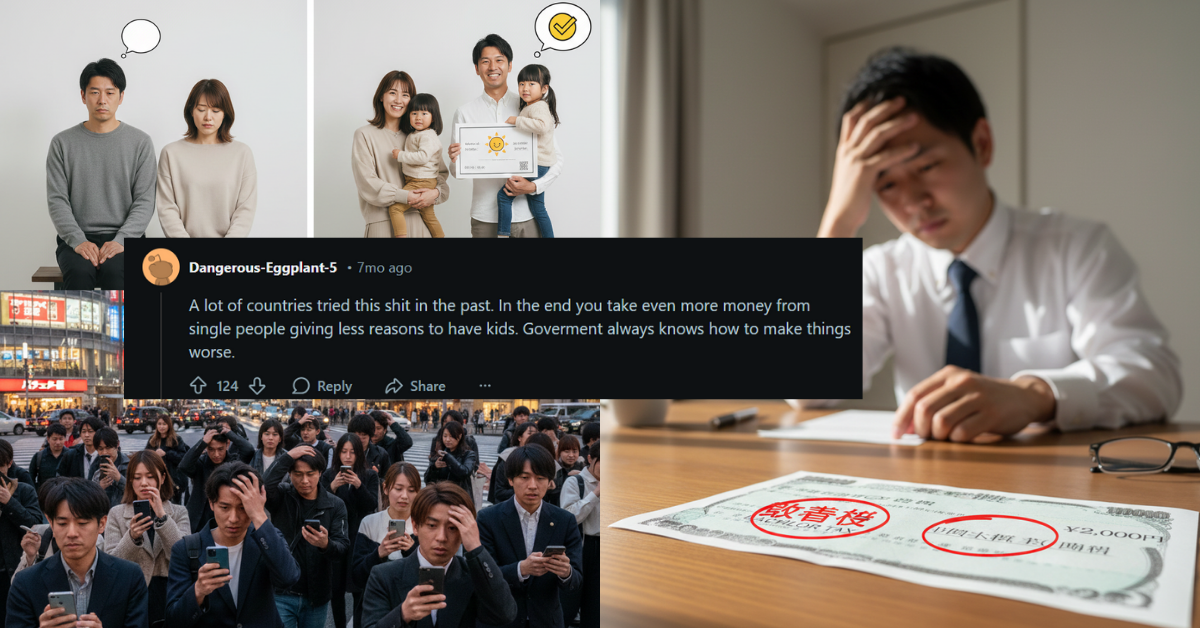
A new policy in Japan has triggered strong public reaction after a video explaining it began spreading online. Many people now call it the “Bachelor Tax,” a name that has quickly gone viral.

The levy is part of the government’s effort to slow down Japan’s shrinking population. While the goal sounds serious, many citizens feel frustrated and confused about why they must pay more.
Japan has been facing a population decline for decades. Birth numbers have dropped sharply since the 1970s, and the country now records far fewer births each year than deaths. In 2024, Japan recorded under 700,000 births, a very low figure for such a large nation.
Immigration remains limited, so fewer young people are entering the country to balance the aging population. This has made population decline a growing concern.
What the “Bachelor Tax” Really is
The policy’s official name is the Child and Child-Rearing Financial Support System, passed in 2025. It will begin in April 2026. Despite its nickname, it is not a direct tax. Instead, it is an added surcharge to national health insurance premiums.
Households earning 10 million yen or more will pay extra each year, with higher earners paying more over time.
Who Pays and Who Benefits
The surcharge applies to all citizens and residents, not just single people. However, only parents will receive financial support from the system.
Because childless people do not get direct benefits, many feel the policy is unfair. This is why the public started calling it the “Bachelor Tax,” even though married couples without children must also pay.
Criticism of the Children & Families Agency
The levy is managed by the Children & Families Agency, which already faces heavy criticism. The agency controls a large budget but is often accused of wasting money on ineffective projects.


Some online discussions have even called for the agency to be dissolved, arguing that direct cash support to families would work better.
Public Frustration Continues to Grow
Government officials claim the surcharge will not increase overall financial pressure, as health insurance adjustments may offset the cost. Still, many young people feel ignored.
Wages have not kept up with rising prices, and they believe government spending favors parents and the elderly. Well-known politicians have also criticized placing this burden on healthcare payments.
As debate continues, it remains unclear whether the new system will actually raise Japan’s birthrate. For now, the “Bachelor Tax” has become a symbol of public frustration, highlighting the gap between government policy and everyday life in modern Japan.
Watch the video here:
Japan will apparently have a Bachelor Tax.
byu/413NeverForget inAsmongold
More from Wake Up Singapore:-
Would You Marry an AI? Japanese Woman Does in Symbolic Ceremony
Not Sex but Companionship—Japan’s New Marriage Trend, ‘Friendship Marriage’
Japan’s New Dating App for Married Couples Has 350K Users and Counting
If you have a story or a tip-off, email admin@wakeup.sg or get in touch via Whatsapp at 8882 5913.
Interested in advertising on our media channels? Reach out to us at admin@wakeup.sg!
Since you have made it to the end of the article, follow Wake Up Singapore on Telegram and X!
Wake Up Singapore is a volunteer-run site that covers alternative views in Singapore. If you want to volunteer with us, sign up here!