

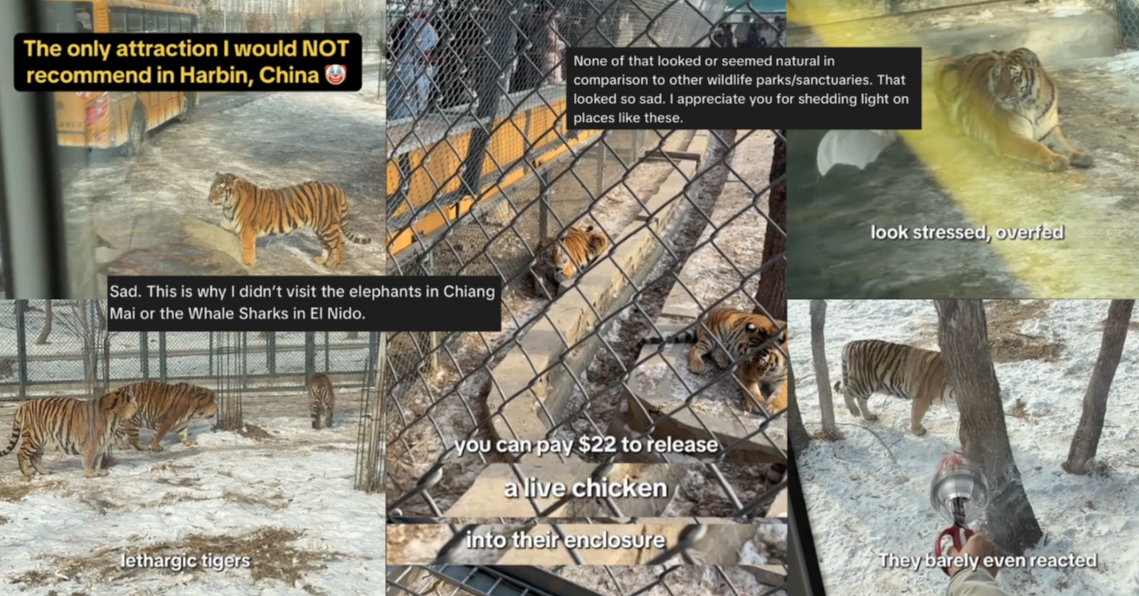
A Singaporean content creator has prompted fresh discussion about wildlife tourism after describing her visit to a Siberian Tiger Park as “one of the most uncomfortable travel experiences” of her life.
Posting on TikTok two days ago, @whereischristie shared footage from the attraction, where visitors ride a bus through a large enclosure housing hundreds of Siberian tigers.
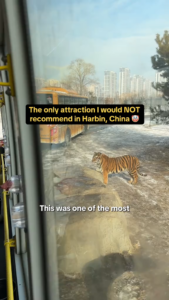
On paper, she said, it sounded exciting, but in reality, she found it deeply troubling.
A Bus Ride Through Tiger Territory
According to her video, visitors pay about S$20 to board a safari-style bus that drives through the enclosure for roughly 45 minutes.
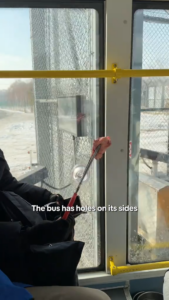
The buses are fitted with holes along the sides. For an additional fee, tourists can purchase slabs of raw meat and use metal tongs to dangle the food outside the vehicle, attempting to feed the tigers as the driver honks to draw them closer.
“These were the biggest, most overweight and lethargic tigers I’ve seen in my life,” she said in the clip.
She added that despite many passengers buying meat, “not a single person managed to feed a tiger,” claiming the animals barely reacted to food held inches from their faces.
Referencing reports that the park saw more than 10,000 visitors in a single day the previous week, she questioned how much additional food the animals might be receiving from tourists.
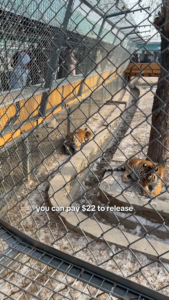
She also highlighted another paid activity — releasing live chickens into the enclosure for the tigers to hunt — which she described as particularly uncomfortable.
“I understand predators hunt, and that’s nature,” she said. “But turning it into a paid spectacle… felt so deeply uncomfortable.”
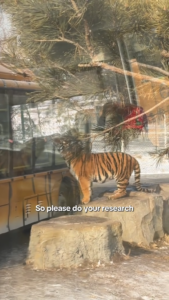
However, reports state that nearly 200 Siberian tigers at the Siberian Tiger Park in Heilongjiang Province have been placed on a rotational “intermittent fasting” programme following a surge in tourist numbers and feeding activity during the Spring Festival holidays. In a notice dated 20 January, the park said the measure — running from 1 February to 31 March — would rotate across 11 free-range enclosures, with one enclosure designated for fasting each day.
On fasting days, visitors are not allowed to feed meat strips in the affected enclosure. A staff member told sources that the move forms part of “scientific management” to optimise feeding regimes while safeguarding the tigers’ health, adding that adjustments may be made depending on operational needs.
“Do Your Research Before Visiting”
In a follow-up comment, the creator acknowledged she had joined the visit as part of a tour group and did not conduct in-depth research beforehand.
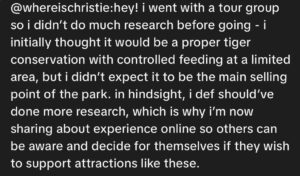
“I initially thought it would be a proper tiger conservation with controlled feeding at a limited area,” she wrote. “I didn’t expect it to be the main selling point of the park.”
She said she shared the experience online so others could make informed decisions about supporting similar attractions.

Her video drew thousands of reactions. Several commenters described the footage as “heartbreaking” and “sad,” while others said they would skip the park after watching.

One commenter pointed out that tigers are solitary animals and do not naturally live in large groups.

According to the World Wildlife Fund (WWF), tigers are indeed solitary by nature, except for mothers with cubs. Individual tigers typically roam vast home ranges and mark territories to signal occupancy. They do not live or hunt in permanent groups in the wild.
A Different Perspective
Not everyone agreed with the criticism.
One commenter who said he had visited the park last month argued that the claim of overfeeding may be overstated. An adult Siberian tiger can require around 8 to 12 kilograms of meat per day, he wrote, adding that with hundreds of tigers in the park, not every animal would receive food from tourists each time.
He also noted that Harbin’s winters can plunge below –30°C, and Siberian tigers are biologically adapted to cold climates, often carrying more body mass for insulation. In his view, a larger appearance does not necessarily indicate poor health.
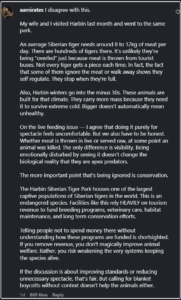
On the live feeding issue, he agreed it may feel uncomfortable, but argued that whether meat is served raw or animals are hunted live, a predator’s diet ultimately involves the death of other animals.
More importantly, he said, the park houses one of the world’s largest captive populations of Siberian tigers — an endangered subspecies — and relies heavily on tourism revenue to fund breeding programmes, veterinary care and maintenance.
“If the discussion is about improving standards or reducing unnecessary spectacle, that’s fair,” he wrote. “But calling for blanket boycotts without context doesn’t help the animals either.”
Longstanding Controversy
Concerns about the park are not new.
Travel blogs, including Travelling Welshman in 2023, have described the tiger safari as “unique” but controversial, noting that visitors can feed both raw meat and live animals such as chickens, goats or cows.
In January, Facebook page Project Nightfall also criticised the park, alleging that tigers appeared noticeably overweight and describing the feeding model as entertainment-driven.
Entertainment or Conservation?
The debate ultimately circles back to a broader question: where is the line between conservation, captivity and commercial spectacle?
Wild tigers are apex predators that hunt independently across expansive territories. Captive breeding centres, however, operate under very different constraints — and often depend on ticket sales.
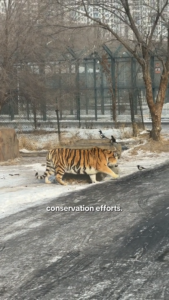
For some visitors, the Harbin park offers rare proximity to an endangered species. For others, including @whereischristie, the experience raises ethical red flags.
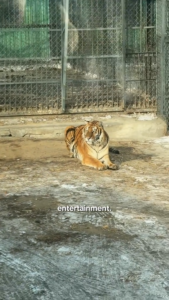
“Please do your research before visiting wildlife attractions,” she urged.
“If something feels unethical, it probably is.”
Whether viewed as conservation-funded tourism or as entertainment crossing ethical lines, the discussion shows no sign of fading — especially as travel content continues to bring such experiences to global audiences.
Watch the video here:
@whereischristie i said what i said 🤡 #tigerpark #harbin #explorechina #travelchina #chinatravel
More from Wake Up Singapore:-
Alpaca Among Other Animals Living in Filth at M’sia Pet Café, Owner Denied Abuse
Woman Arrested and Charged With Animal Cruelty After Grooming Abuse Video Goes Viral
Customer Throws Drink, Hurls Abuse at Zus Coffee Employee—Zus Stands with ‘Zurista’
If you have a story or a tip-off, email admin@wakeup.sg or get in touch via Whatsapp at 8882 5913.
Interested in advertising on our media channels? Reach out to us at admin@wakeup.sg!
Since you have made it to the end of the article, follow Wake Up Singapore on Telegram and X!
Wake Up Singapore is a volunteer-run site that covers alternative views in Singapore. If you want to volunteer with us, sign up here!