
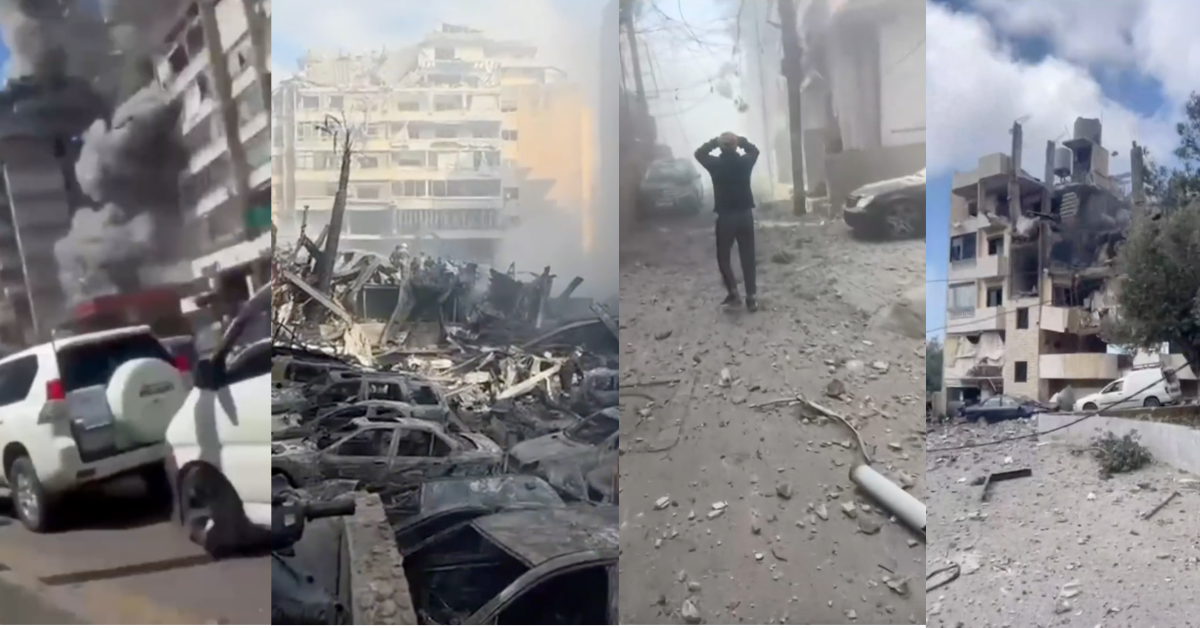
In less than 24 hours after the US-Iran ceasefire, Israel has carried out the largest coordinated attack against Lebanon since the beginning of the war. Israeli strikes hit densely populated residential and commercial areas in central Beirut and Dahieh during midday rush hour.
Lebanon’s Civil Defence said at least 254 people were killed and 1,165 others were wounded in the attacks on Wednesday, 8 April.
According to Lebanon’s Health Minister Rakan Nassereddine, hospitals across Lebanon are overcrowded with victims, and are appealing for blood donations in response to mass casualties.
The Israeli military referred to this coordinated attack as operation “Eternal Darkness”, claiming to target Hezbollah command centers. Within minutes, the Israeli military launched attacks on at least 48 areas, including on crowded residential neighbourhoods and civilian infrastructure, in the south of Lebanon, north of Lebanon, Mount Lebanon, Bekaa, Beirut suburbs and central Beirut. These strikes came just 10 minutes of issuing an evacuation order for the southern suburbs of Beirut and the city of Tyre.
Under international law, attacks on civilian infrastructure, including homes and bridges, are generally prohibited.
The Israeli military, “carried out a surprise strike on hundreds of Hezbollah terrorists at command centres across Lebanon. This is the largest concentrated blow Hezbollah has suffered since Operation Beepers,” said the Israeli Defence Minister, Israel Katz, in a video statement, referring to a major 2024 operation against Hezbollah involving pager bombs that wounded more than 3,000 people and killed 12, including two children.
Repercussions on the US-Iran ceasefire agreement
Iranian officials have confirmed that Iran will withdraw from the ceasefire agreement if Israel continues attack Lebanon, and the Strait of Hormuz is reportedly closed again. Ending all Israeli strikes on Lebanon was a prerequisite to the 10-point peace plan set out by Iran in the US-Iran ceasefire terms on 8 April.
Israel’s history of invading Lebanon
At the time of writing, Israel is continuing to strike southern Lebanon, in the areas of Beit Yahoun, al-Jumaijmah, and Majdal Selm.
Israel has repeatedly invaded Lebanon in recent decades, and occupied the south until 2000. Over 1.2 million Lebanese – one-fifth of the total population – are displaced from South Lebanon due to Israeli military incursions and border fighting with Hezbollah beginning in November 2024. The Israeli military has reportedly faced stiff Hezbollah resistance since invading Southern Lebanon. Since March 13, the Israeli military has destroyed five bridges over the Litani and demolished homes in border villages to create a “buffer zone”. Such a buffer zone would require long-term occupation, and raises concerns that displaced residents may never be able to return.
More from Wake Up Singapore:-
Pakistan abstains on the UN Hormuz resolution, urges restraint and sustained diplomatic dialogue
If you have a story or a tip-off, email admin@wakeup.sg or get in touch via Whatsapp at 8882 5913.
Interested in advertising on our media channels? Reach out to us at admin@wakeup.sg!
Since you have made it to the end of the article, follow Wake Up Singapore on Telegram and X!
Wake Up Singapore is a volunteer-run site that covers alternative views in Singapore. If you want to volunteer with us, sign up here!